
Farming in different realities: what a road trip across South America reveals about agriculture
A road trip across South America showed how agriculture adapts to very different environments and reinforced the role of management and technology in the field.
 Jonas Rotilli
CEO and founder of upCampo
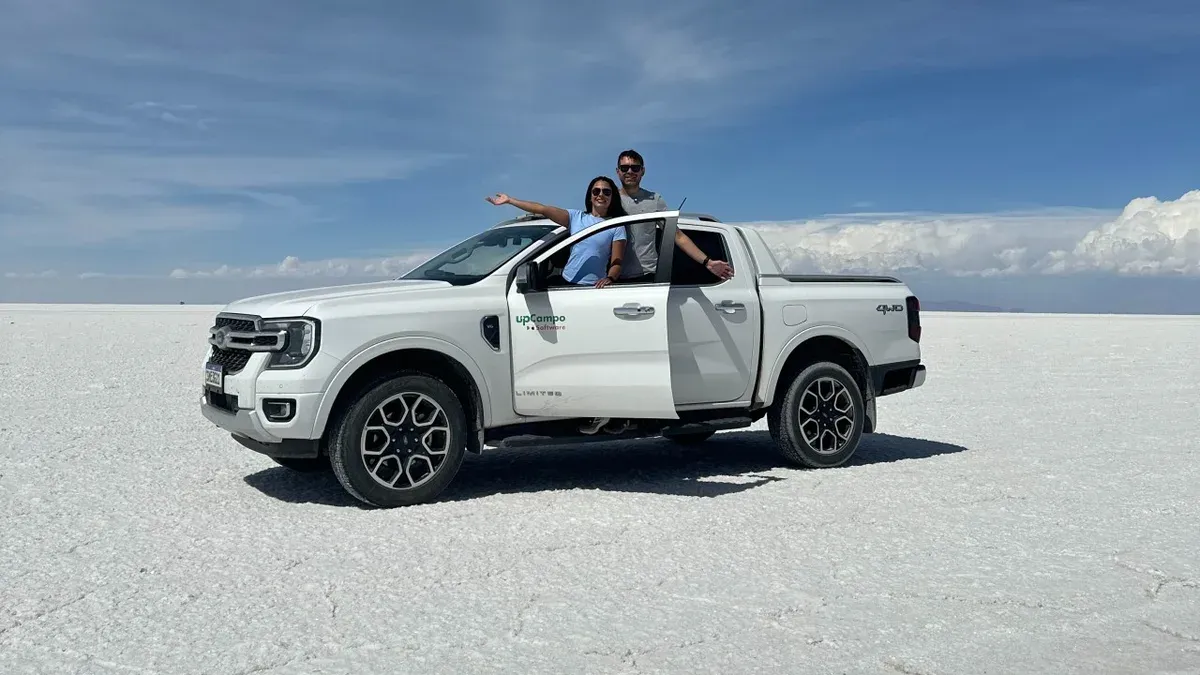
By Jonas Rotilli, founder of upCampo.
This was our “vacation,” my wife’s and mine — Nayara Aguero. In practice, a project we had been putting off for years — and finally made happen.
Traveling by car changes everything. Every mile brings a different landscape, a different culture, a different way of producing food. And since I work with agriculture every day, I took the chance to look closely at how it shows up along the way.
From Mato Grosso to Acre
Leaving Cuiabá toward Rondônia, via Cáceres, the scenery is mostly cattle ranching. Grain fields start to appear farther north, near the state line. In Rondônia, especially around Vilhena, farming picks up, with beautiful cropland.
Rondônia is a very beautiful state and a new agricultural frontier in full expansion. All the way to Porto Velho, there is an interesting mosaic of cattle and crops. After that, cropland thins out and ranching takes over again.
In Acre, the pattern is similar: lots of cattle. But past Rio Branco came a pleasant surprise — well-run soybean fields, farms with grain bins and a level of organization I did not expect to find there.
And even thousands of miles away, we kept up with the farms’ routine. With a Starlink in the car and upCampo, we proved you can manage things remotely: follow activities, check information, exchange messages and keep a finger on the pulse of the operation. It does not replace being in the field, of course, but it brings peace of mind and continuity.
Peru: farming at altitude
Crossing into Peru, the landscape changes completely. A bit of ranching at first, but the Peruvian Amazon soon takes over — forest, timber. About 400 km past the Brazilian border, the climb into the Andes begins. And then reality changes radically.
Mountains, extreme altitude, challenging roads. We reached nearly 4,725 meters above sea level. In this region, farming is basically potatoes, and livestock means alpacas and llamas, all small-scale and extremely adapted to the environment.
Heading down to Cusco, at about 3,399 meters, we reached the famous Sacred Valley. Mountains, a river cutting through the valley and life going on there for centuries. It is impossible not to be impressed by Inca wisdom.
We visited the archaeological site of Moray, which you could call an “Inca research station”: circular terraces used to test crops at different altitudes and microclimates. Potatoes at the highest levels. Corn at the lowest. Lots of corn.
Corn in Peru is something else. It shows up at breakfast, lunch and dinner — in many colors, varieties and dishes. We brought back a set of seeds that shows this diversity well. It is an extremely rich genetic heritage.
Chile, Bolivia and Argentina
Going down from Peru into Chile, the landscape gets drier and drier. From the coast to the Atacama, desert dominates. Farming appears only in isolated valleys, always near rivers, on a small scale — and, of course, always with corn.
The Atacama Desert is the real thing. Alpaca and llama herding dominate, along with a strong mining presence.
In Bolivia, we went to see the Uyuni Salt Flat, near the borders with Chile and Argentina, where we again found high altitude, potatoes, alpacas and mining.
Entering Argentina, after crossing the Andes while still in Bolivia, we started to descend. Cattle ranching reappears, now closer to what we see in Brazil.
In Jujuy province, there are still mountains and valleys that recall Peru, with family farming all around. In Salta, we visited Cafayate — a stunning region, a cradle of Argentine wine, full of vineyards.
Leaving the mountains, the land opens up. And then come crops that look a lot like Brazil: sunflower, soybeans and even cotton, in the Argentine Chaco region.
Paraguay and the trip home
In Paraguay, from Asunción to Ponta Porã, the highlight is the central stretch: very well-managed farmland, beautiful crops.
Back in Brazil, through Mato Grosso do Sul, the season looked excellent. Steady rain and remarkably good-looking crops, especially between Ponta Porã and Dourados — a region now dominated by soybeans, where there used to be a lot of cattle.
From Campo Grande to Chapadão do Sul, the region is well established. In the parts of Mato Grosso we drove through, conditions were also great, with good rain.
What stayed with us
It was a fantastic experience: 10,795 kilometers driven in 29 days, between November and December 2025.
What struck us most was the diversity — of landscapes, cultures and production systems — and, above all, humanity’s ability to adapt to the most extreme environments.
It also became even clearer that connectivity and organization make a difference, even when we are far away — the same idea behind farm operations management. Traveling like this broadens your view. And that view comes back with us to work, to our decisions and to the way we see the field.