Grupo C.: 16,000 hectares of cotton, an integrated John Deere fleet and the operation tracked live
How Grupo C., in Lucas do Rio Verde (MT), manages 16,000 hectares of cotton on upCampo, with John Deere, Sankhya, Davis and Agrosystem integrated and five live dashboards.
By upCampo
Grupo C., based in Lucas do Rio Verde, in the Brazilian state of Mato Grosso (MT), runs eight farms with about 16,000 hectares of cotton, plus soybeans, and a 100% John Deere fleet. The office works on the Sankhya ERP; operations management runs on upCampo: planning, pest scouting, phenology by reproductive node, agronomic recommendations, work orders, inventory, cost, weather and bale traceability, with Sankhya, John Deere Operations Center and the Davis and Agrosystem weather stations integrated. Five dashboards built for the group show the operation live, and the owners follow everything from their office in town.
How Grupo C. found upCampo
Nobody sold it to them. The group found the app in the app store and started with a single problem: pest scouting. Over time, it brought almost all of the operations management of its eight farms into the same database.
The group’s agronomist used a different scouting tool before. Today he writes spray recommendations directly in upCampo, and the gain he highlights is organization and planning.
The operation on the platform, in numbers
| Records in upCampo | Count |
|---|---|
| Farms | 8 |
| Cotton area | about 16,000 ha |
| Work orders | 13,000 |
| Field scouting reports | 17,000 |
| Bales recorded | 149,000 |
These are records from the operation itself, entered by the group’s team over several seasons.
What the group does on upCampo
Pest scouting and cotton phenology
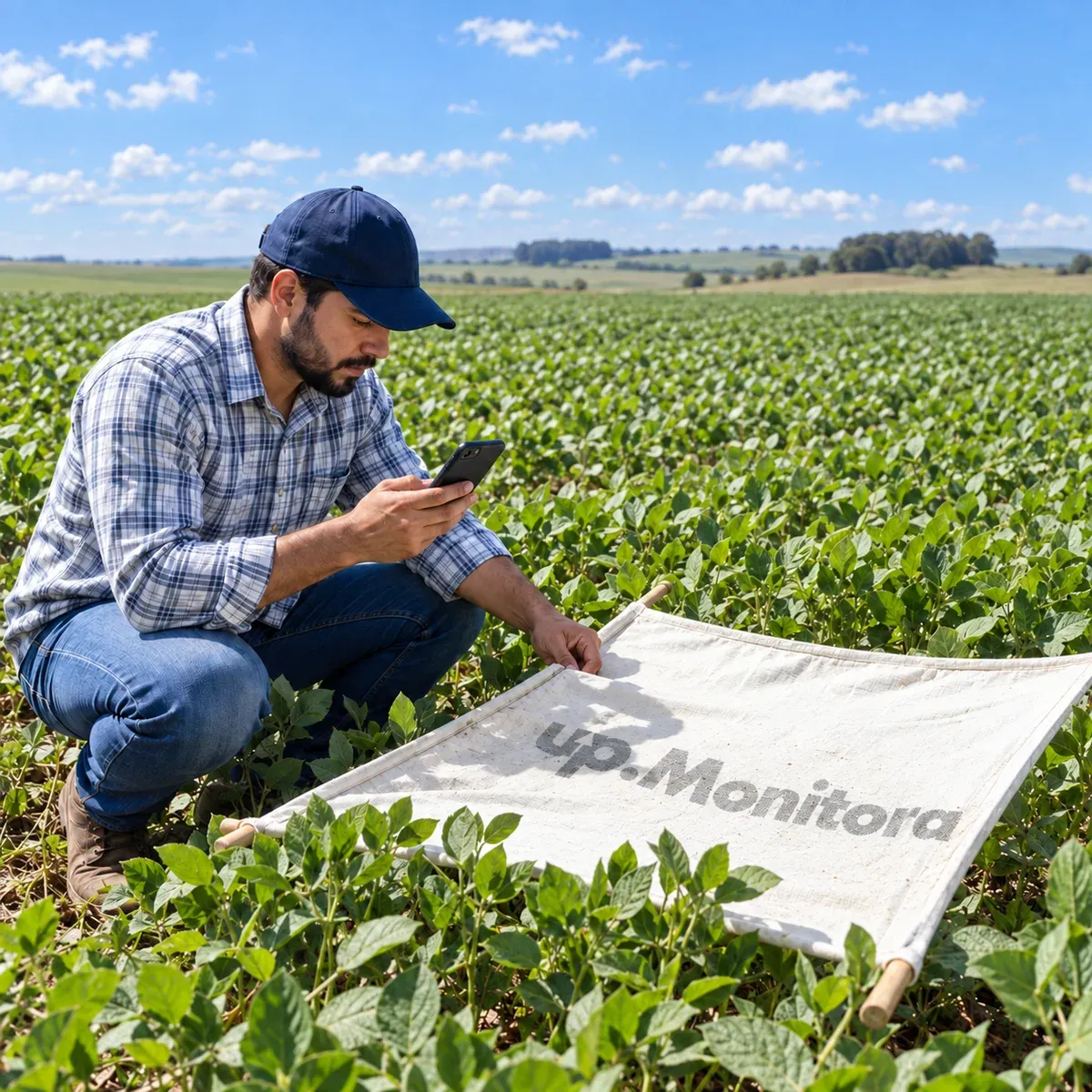
Technicians scout through the app, in the field, with the coordinates of each point. In cotton, besides pests, the scouting report measures the plant itself: squares, small, medium and large bolls, bolls by position (1 to 5), rotten bolls and open bolls — the fields are described on the Scouting screen in the Help Center.
upCampo’s Phenology module was born at this customer. It’s an extremely technical group, with a detailed crop history and true precision agriculture, and an active partner in developing the platform. Much of what is measured in cotton phenology today is what its team asked to measure.
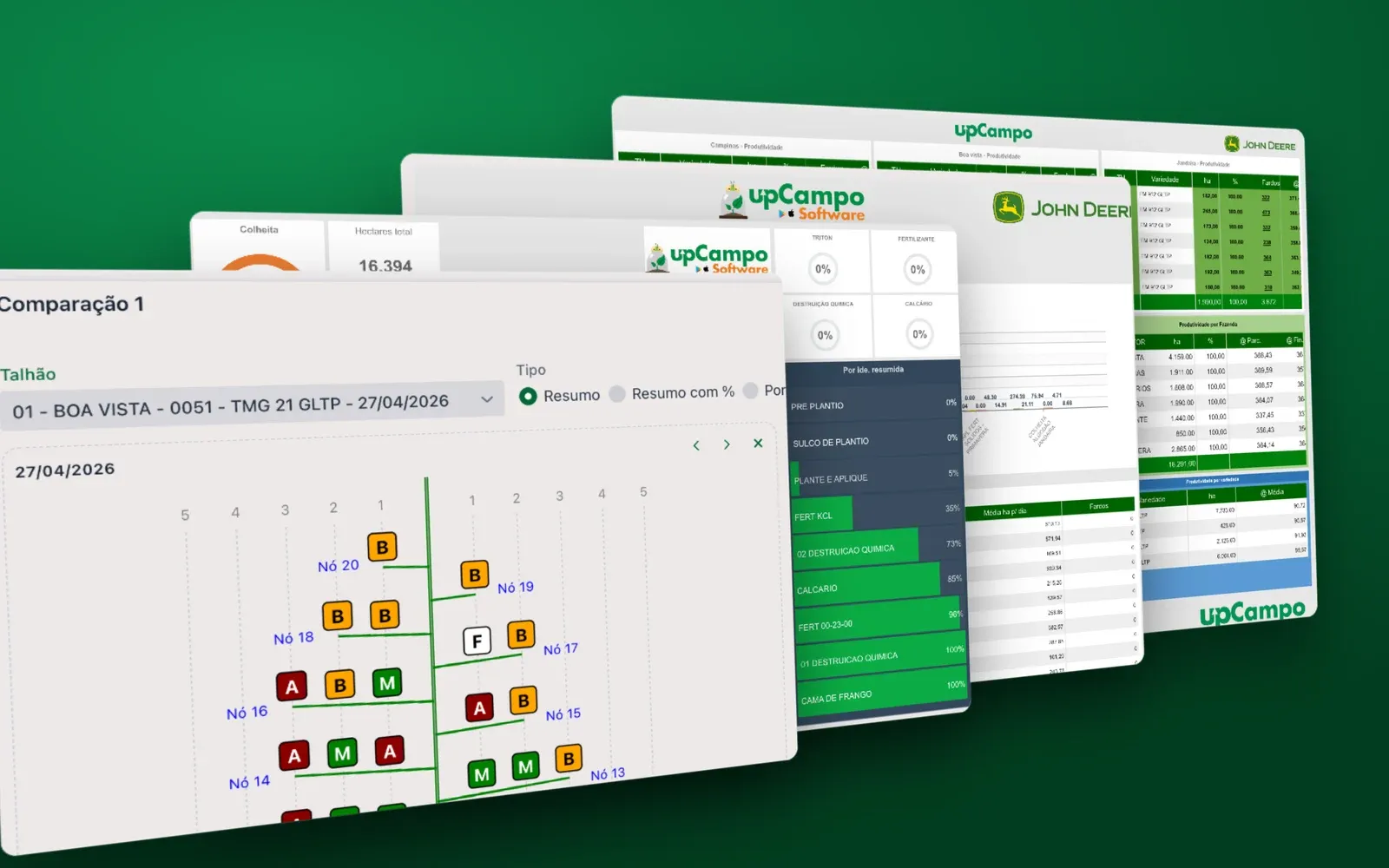
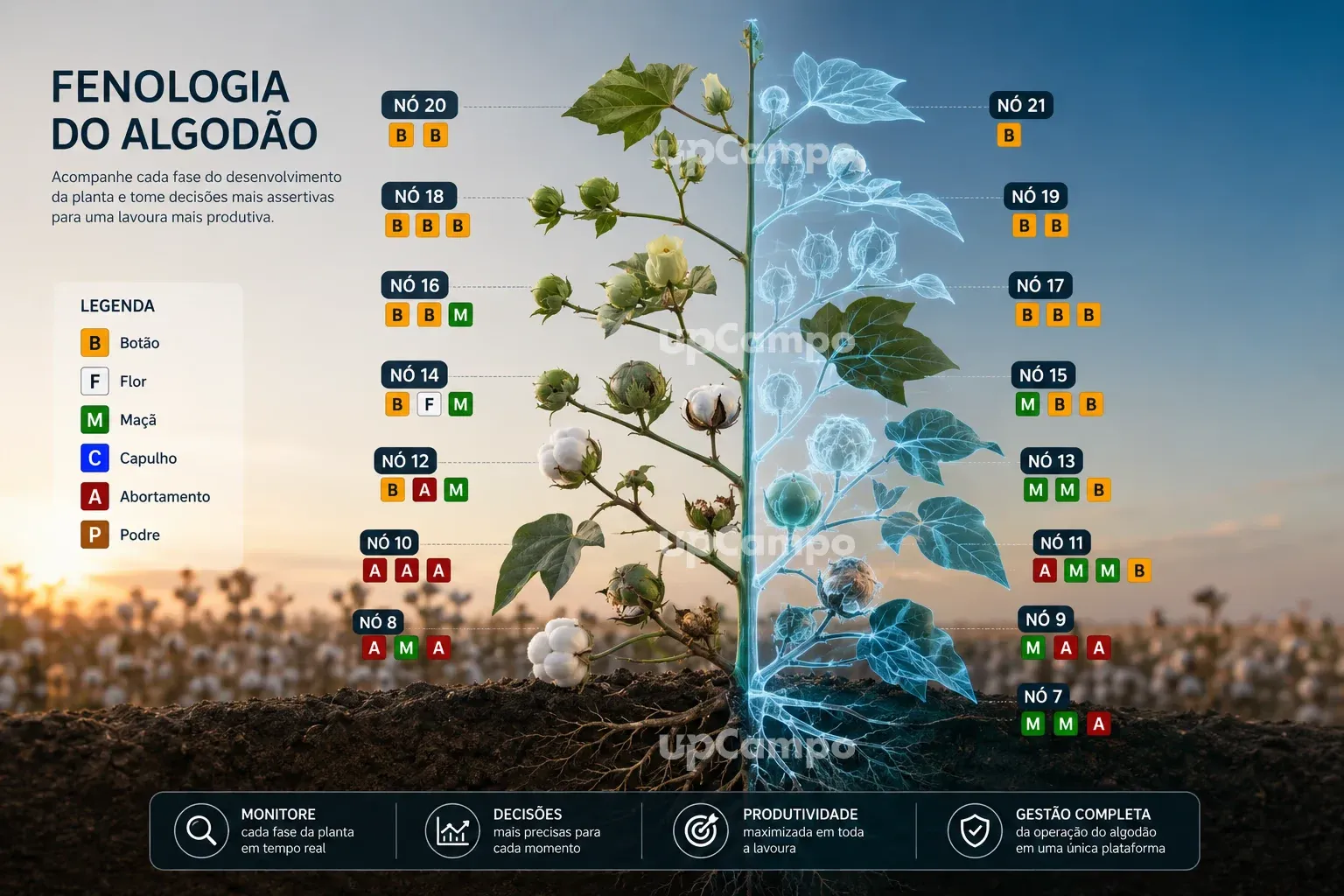
At Grupo C., phenology goes down to reproductive node mapping: node by node, the plant is recorded with square, flower, boll, open boll, abortion or rotten boll. To compare these maps, upCampo built a dashboard where the agronomist puts fields and dates side by side — as a summary, in percentages or plant by plant.
From recommendation to work order
The agronomist’s recommendation is recorded in the Agronomic Prescription: product, rate, crop and total quantity. From there, upCampo tracks how much of the prescription has been used and how much is left.
The application becomes a work order: which fields, which products, which machine and which crew. The work order is what records the crews’ execution in the field.
The detail goes deep. In aerial application, the spray mix is calculated flight by flight: the worker preparing it follows on a tablet how much of each product goes into each flight.
Inventory and cost per field
The product a work order consumes comes out of inventory, and its value goes into the field’s cost. With 13,000 work orders recorded, the group’s season cost is built from what was actually done — the method is explained in how to calculate cost per field.
John Deere Operations Center integrated
With an all-John Deere fleet, the group has a detailed machine record of everything the harvester, sprayer and tractor did. The Operations Center integration brings that record into management, where it meets the work order, inventory and cost.
The integration is read-only: upCampo reads from Operations Center and doesn’t write to it. In each machine’s record, one click on the serial number opens the machine directly in Operations Center. When a field or operation has a different name in each system, the mapping between records is set up once.
Bales: from field to gin
Each harvested module is a record with a number, field of origin, variety and harvest date. It’s the traceability unit for cotton: from a lint bale, you can trace back to the cotton module and the field that produced it. The group has 149,000 bales recorded, and the full chain is in cotton traceability, from module to bale.
Weather: Davis and Agrosystem stations integrated
The farms’ Davis and Agrosystem weather stations send their data to upCampo automatically, with no one typing in readings. Rainfall and weather for each farm sit in the same database as the operation, next to scouting reports and work orders.
Sankhya in the office, integrated with the operation
The group didn’t switch ERPs to use upCampo. Sankhya stays in the office, handling tax and administration; upCampo takes care of what happens in the field, from pest scouting to the bale. The two systems exchange data, and the ERP receives the operation’s cost built from what was executed — that’s where the numbers leadership follows come from.
Five live dashboards, followed from the office
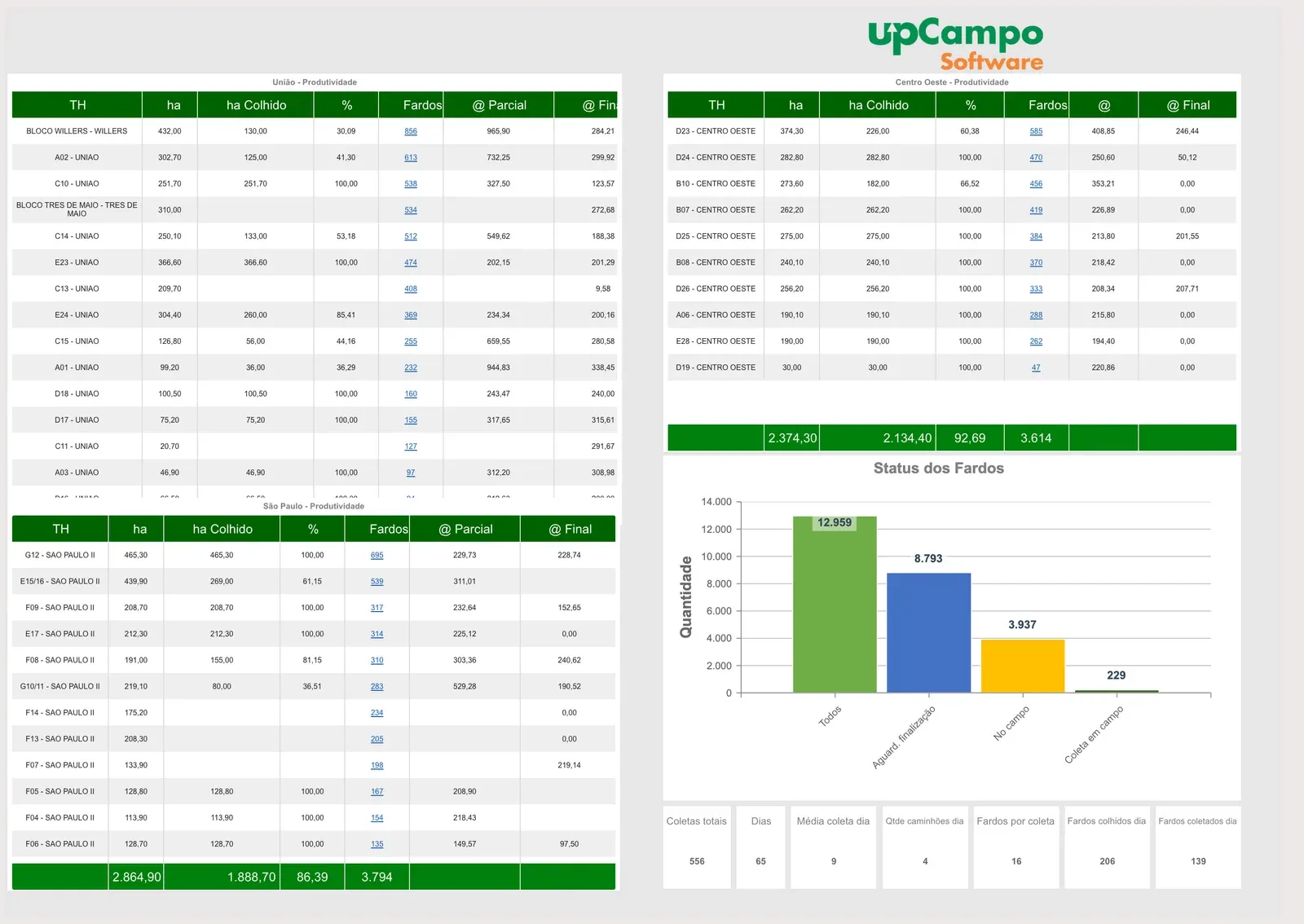
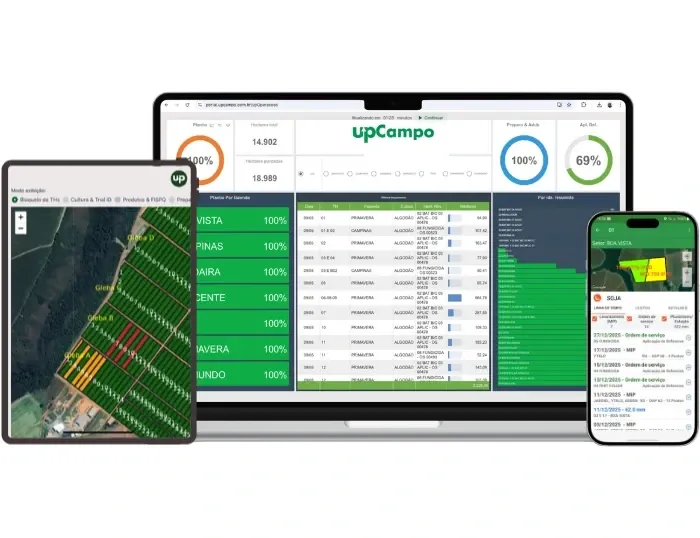
The owners don’t need to be on the farm to know how the operation is going. upCampo built five dashboards for the group that update on their own, live, and that they follow from their office in town:
- Operations — the operation at a glance: harvest progress by farm, hectares, latest entries and the progress of each activity.
- Machines — John Deere Operations Center data organized the way management needs it: hectares, hours, days worked, fuel use and efficiency per machine, grouped by farm and by crew, something Operations Center doesn’t do.
- Operational performance — the performance of field operations.
- Yield — arrobas (a Brazilian unit of 15 kg) and bales per field, per farm and per variety.
- Cotton phenology — reproductive node mapping compared across fields and dates.
Beyond the dashboards, the group has many custom reports, built by the upCampo team for the questions it asks about the operation.
The group during this period
During its partnership with upCampo, the group expanded its cotton gin, grew its trucking company and is finishing a biologicals plant. These aren’t results attributed to the system — they’re the context of an operation that grew and kept its management in the same database.
“We’ve used different farm management systems over the years, but upCampo was the one that best adapted to the reality of our operation. The John Deere integration, together with managing activities and costs, brought much more organization and clarity to the farm.”
— Agricultural technology consultant, Grupo C.
Who this case is for
Cotton groups with several farms and a John Deere fleet, who already have plenty of machine data and want it tied to work orders, inventory and cost — with leadership following the operation live, wherever they are. See how upCampo handles cotton from field to bale.
Frequently asked questions
Does upCampo integrate with John Deere Operations Center?
Yes. upCampo reads machine records from John Deere Operations Center and links them to the work order, inventory and cost per field. The integration is read-only: nothing is written, changed or deleted in Operations Center. Grupo C., in Lucas do Rio Verde (MT), uses this integration with a 100% John Deere fleet across eight cotton farms.
Can a group with several cotton farms organize everything on upCampo?
Yes. Grupo C. keeps eight farms and about 16,000 hectares of cotton on upCampo, with 13,000 work orders, 17,000 field scouting reports and 149,000 bales recorded. The data leadership uses to follow the farm operation comes from the platform.
Can I track cotton phenology on upCampo?
Yes. In the scouting report done in the app, the technician records squares, bolls by size and position, rotten bolls and open bolls, as well as pests. At Grupo C., in Lucas do Rio Verde (MT), where the Phenology module was born, phenology goes down to reproductive node mapping, compared across fields and dates in a dedicated dashboard.
Does upCampo integrate with Sankhya?
Yes. Grupo C., in Lucas do Rio Verde (MT), uses Sankhya as its office ERP, integrated with upCampo: the two systems exchange data, and the ERP receives the operation’s cost built from what was executed in the field.
Does upCampo integrate with Davis and Agrosystem weather stations?
Yes. Davis and Agrosystem stations send their data to upCampo automatically through an integration, and rainfall and weather sit next to each farm’s operation. Grupo C., in Lucas do Rio Verde (MT), uses this integration alongside the John Deere Operations Center one.
Can I follow the farm operation live from the office?
Yes. For Grupo C., upCampo built five dashboards that update on their own — operations, machines, operational performance, yield and cotton phenology — and the owners follow the farms’ operation from their office in town.
Does upCampo calculate the spray mix for aerial application?
Yes. The work order calculates the spray mix, and at Grupo C. the calculation is done flight by flight in aerial application: the worker follows on a tablet how much of each product goes into each flight.
Can the agronomist write spray recommendations on upCampo?
Yes. The recommendation goes into the Agronomic Prescription, with product, rate, crop and total quantity, and upCampo tracks the balance used in work orders. At Grupo C., the agronomist replaced the scouting tool he used before and now writes recommendations directly on the platform.
Does upCampo trace a cotton bale back to the field?
Yes. Each module is recorded with a number, field of origin, variety and harvest date, and each lint bale points to its source module. That way, a sold bale traces back to the field that produced the lint. Grupo C. has 149,000 bales recorded on the platform.
Do I have to roll out the whole system at once?
No. Grupo C. started with pest scouting only and gradually brought the rest of its operations management into the same database, without switching systems along the way.